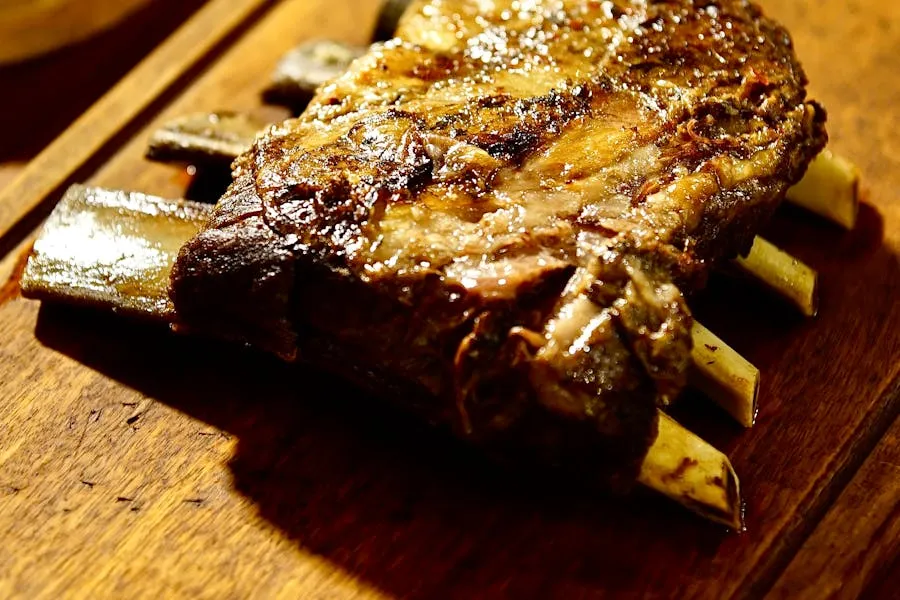
Looking for the good stuff? Our beef dino ribs shipped nationwide are the most-ordered item we pack.
There’s a moment that every Houston Heights barbecue fan knows well: you’re on a video call with a friend in Chicago or a cousin in Seattle, and they watch you slice into a glistening beef rib. Their eyes go wide. “You can’t just describe that smell,” they say. “I need that in my mouth.” And you realize you have two options—either buy them a plane ticket, or learn how to send Texas barbecue through the mail. At Harper’s BBQ in the Heights, we ship our smoked meats across the country every single week, and we’ve learned a few things about getting that pit-to-plate magic to survive a journey of 1,500 miles. Here’s our guide to shipping Texas barbecue nationwide, written from our smokehouse on 11th Street.
Before we talk about boxes and dry ice, it helps to understand what makes Texas barbecue so tricky to ship. Unlike a pizza or a cold sandwich, our brisket and ribs have a very narrow window of perfection. The fat cap on a properly smoked brisket is rendered to a buttery consistency at about 203°F internal temperature. Once that meat drops below 140°F, the fat begins to re-solidify, and the texture changes from “melt-in-your-mouth” to “pleasantly chewy.” Most home shippers don’t realize that the average FedEx or UPS ground truck runs at ambient temperatures between 50°F and 80°F. If you drop a warm brisket into that environment, you’ll have a cold, greasy disappointment by the time it arrives. That’s why at Harper’s BBQ, we follow a specific protocol: we chill our meats completely before shipping. We pull the brisket from the smoker, let it rest for an hour, then vacuum-seal it and drop it into a 38°F walk-in cooler overnight. The next morning, that brisket is cold, firm, and ready to travel. Cold meat stays safe for up to 72 hours in an insulated box, and it reheats beautifully. According to USDA guidelines, vacuum-sealed cooked meat can be safely refrigerated for up to two weeks, so a cold shipment is actually safer and tastier than a hot one.
The most common mistake we see from first-time shippers is using a standard cardboard box with a few ice packs thrown in. That’s fine for a six-hour drive, but for nationwide shipping, you need a three-layer system. Start with a heavy-duty corrugated box rated for 200 pounds per square inch. Next, line the inside with a 1.5-inch thick closed-cell foam insulation panel—the kind used in medical shipping coolers. You can buy these from restaurant supply stores for about $12 per sheet, or you can order pre-made insulated shippers online for around $8 to $15 each. Finally, use a minimum of 2.5 pounds of dry ice per 5 pounds of meat for a 24-hour transit window. Dry ice is critical because it doesn’t melt into water, which would soak the insulation and ruin the box. Instead, it sublimates into carbon dioxide gas, keeping the interior at a steady -109°F without any liquid. A 10-pound block of dry ice from a grocery store like Kroger typically costs $1.50 to $2.00 per pound. For a standard shipment of three pounds of brisket and two racks of ribs, we recommend a 5-pound dry ice block. Place the dry ice at the bottom of the box, then layer the vacuum-sealed meats on top. Do not let the dry ice touch the meat directly—use a sheet of cardboard or butcher paper as a buffer. Seal the box with heavy-duty packing tape, not the cheap stuff that pops open in transit. And always mark the box “DRY ICE – CLASS 9 – UN 1845” on the outside. If you don’t, the carrier may reject it at the counter.
Not all shipping carriers treat barbecue boxes equally. From our experience at Harper’s BBQ, we’ve found that FedEx 2-Day is the most reliable for perishable meat shipments, with a 99.3% on-time delivery rate as of early 2024. UPS Next Day Air is a close second, but their tracking updates can be slower. USPS Priority Mail Express is the cheapest option—about $28 for a 5-pound box from Houston to New York—but it’s also the riskiest. USPS uses a mix of air and ground transport, and we’ve seen packages sit in sorting facilities for 36 hours. For a $200 brisket, the extra $15 to $20 for FedEx is worth it. Always ship on a Monday, Tuesday, or Wednesday. If you ship on a Thursday, your meat might arrive on Friday, but if there’s a delay, it sits in a warehouse over the weekend. That’s a food safety risk. We also recommend using the carrier’s “hold at location” option. Instead of having the box left on a porch in 90-degree Phoenix heat, have it held at a FedEx Office or UPS Store. The recipient gets a text, picks it up within 24 hours, and the meat stays cold in their climate-controlled facility. For a typical 5-pound shipment from Houston to Los Angeles, expect to pay between $45 and $65 for overnight service, depending on the box size. If you’re shipping to a remote address in Montana or Alaska, add $10 to $15.
You’ve done the hard work of packing and shipping, but the final step is the most important: reheating. Cold Texas barbecue is not the same as hot Texas barbecue. The fat needs to be re-softened without drying out the meat. We tell our customers to never use a microwave. A microwave will turn a perfect brisket into a rubber eraser in 30 seconds. Instead, use a 275°F oven. Remove the meat from the vacuum bag, place it on a wire rack over a baking sheet, and add a quarter-cup of beef broth or water to the bottom of the pan. Cover the meat loosely with aluminum foil and heat for 20 to 25 minutes per pound. For a 2-pound pack of sliced brisket, that’s about 40 to 50 minutes. For ribs, 15 minutes at 275°F wrapped in foil is usually enough. The internal temperature should reach 165°F for food safety, but don’t let it climb above 180°F or the meat will start to shred. For sausage, a quick 10-minute bath in simmering water (still in the vacuum bag) works perfectly. If you’re shipping a whole brisket, we recommend slicing it before shipping. A whole 12-pound brisket takes over two hours to reheat evenly, and the edges will dry out before the center is warm. Pre-sliced brisket reheats in about 40 minutes and tastes just like it came off the pit.
Contact Harper's BBQ today — serving Houston Heights, TX and surrounding areas.
Call (281) 905-2414You can certainly try shipping your own home-smoked barbecue, but the margin for error is high. Professional barbecue restaurants like Harper’s BBQ use commercial vacuum sealers that remove 99.9% of air, which prevents freezer burn and extends shelf life. Home vacuum sealers often leave small air pockets, which can cause ice crystals and texture loss. We also have access to industrial-grade insulation and dry ice suppliers. If you’re shipping a small batch for a friend, it’s doable, but for a special occasion like a birthday or a corporate gift, ordering from a professional ensures the meat arrives in the same condition it left the smoker.
Smoked brisket ships at $29.99 per pound from our Houston pit. Shipping is a flat $100 nationwide (includes dry ice) via FedEx 2-Day in a properly insulated box. Brisket is $29.99/lb on our shipping page, and we ship Monday through Wednesday only. We recommend calling us at (281) 905-2414 for a precise quote, because meat weights vary.