In the heart of Houston Heights, where the scent of post oak smoke drifts through century-old bungalows and the sound of train horns is as familiar as a neighbor’s greeting, there’s a singular truth that defines our community: we don’t just eat barbecue; we study it. As a local pitmaster and the owner of Harper’s BBQ, I’ve spent the better part of two decades standing in front of a 1,000-gallon offset smoker, learning exactly what separates a good brisket from a transcendent one. It’s not magic. It’s science, patience, and a very specific relationship between fire and meat. Today, I’m going to walk you through exactly how we make real Texas brisket—the 14-hour post oak smoke process that turns a tough cut of beef into something that practically dissolves on your tongue.
The journey of a great brisket begins long before the fire is lit. It starts with the grade of the meat. At Harper’s BBQ, we use only USDA Prime brisket, a decision that adds roughly $3.50 to $4.00 per pound in raw cost compared to standard Choice grade. That extra marbling—those thin ribbons of fat running through the muscle—isn’t just cosmetic; it’s the primary engine for moisture and flavor during a long cook. A typical whole packer brisket we bring in weighs around 14 to 16 pounds. After trimming off the hard fat cap and the silver skin, we lose about 15 to 20 percent of that weight before it ever hits the smoker. That’s a real cost, and it’s why a properly cooked brisket isn’t cheap. You’re paying for the meat that remains, not the fat that gets rendered away. We season our briskets with a simple, coarse blend of kosher salt and 16-mesh black pepper—roughly a 50-50 ratio by volume. That’s it. No sugar, no paprika, no secret rubs. In Texas, the smoke is the spice.
Now, let’s talk about the fire. The single most important variable in brisket is the wood, and in Houston Heights, we are blessed with an abundance of post oak. It’s a dense, slow-burning hardwood that produces a clean, mild smoke with a distinct nutty character. We don’t use mesquite—it burns too hot and turns meat acrid. We don’t use hickory—it’s too heavy for a 14-hour cook. Post oak, split into logs about the size of your forearm, is our only fuel. The fire management is an art of constant attention. We maintain a cooking chamber temperature between 250 and 275 degrees Fahrenheit. If it drops to 225, the brisket stalls and the fat doesn’t render. If it spikes to 300, the outside dries out before the inside is done. I check the firebox every 20 to 30 minutes for the first eight hours, adding a fresh split log each time. That’s roughly 30 to 35 pounds of wood per brisket, per cook. It’s labor-intensive, but it’s the only way to get that deep, mahogany bark.
The 14-hour timeline breaks down into three distinct phases. The first four hours are the “smoke absorption” phase. The brisket is cold from the fridge, and the surface is wet. As the meat warms up, it accepts smoke readily. We place the brisket on the smoker with the fat cap facing the firebox, so the fat acts as a thermal buffer. During this phase, we don’t open the lid. Every time you open a smoker, you lose heat and you disrupt the airflow. After four hours, the internal temperature of the brisket typically hits around 140 degrees. The second phase is the “cook” phase, from hour four to hour ten. This is where the collagen in the connective tissue begins to break down into gelatin at around 170 degrees. The brisket will hit a notorious “stall” at around 155 to 165 degrees, where the surface evaporation cools the meat faster than the fire heats it. This stall can last two to three hours. We don’t wrap in foil or butcher paper until the bark has set—usually around hour eight, when the internal temperature hits 170. We wrap in uncoated peach butcher paper, which allows the meat to breathe while trapping some steam. After wrapping, the temperature climbs more quickly, and by hour twelve, we’re usually looking at an internal temperature of 195 to 203 degrees. That’s the window. We probe the thickest part of the flat—the lean end—with a thermometer probe. It should slide in like a hot knife through butter. No resistance. That’s the tell.
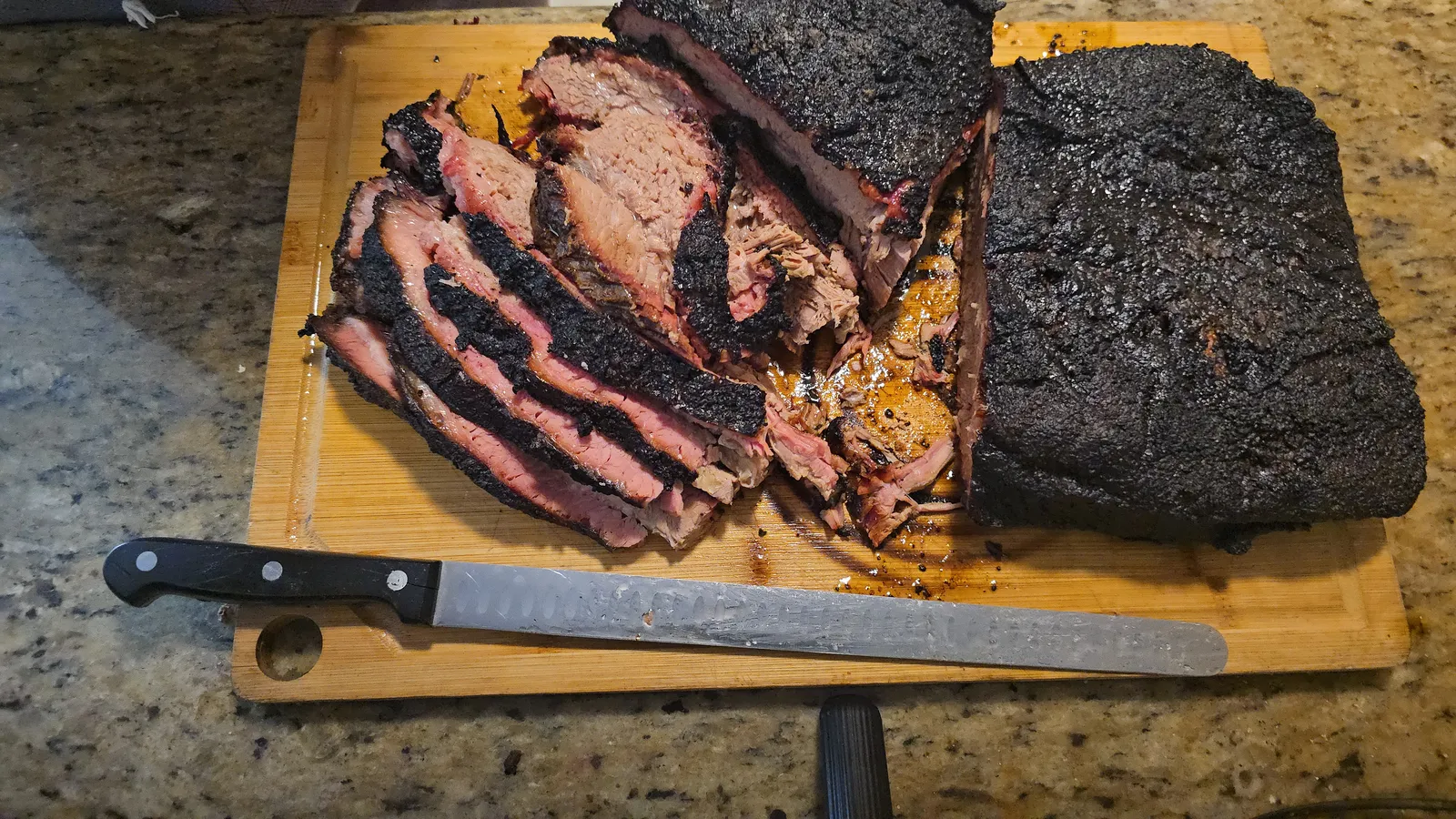
The final two hours are for resting. This is the most overlooked step in home barbecue, and it’s where we earn our reputation. We take the wrapped brisket off the smoker and place it in a dry-hold warmer set at 140 degrees. It rests for a minimum of two hours, sometimes longer. During this rest, the juices that have been driven to the center of the meat redistribute evenly throughout the entire brisket. If you slice a brisket fresh off the smoker, those juices will run out onto the cutting board. If you rest it properly, they stay inside the meat. The result is a slice that glistens without being greasy, with a dark, peppery bark that crunches slightly before giving way to a buttery, tender interior. When we slice for a plate at Harper’s BBQ, we cut against the grain, about the thickness of a No. 2 pencil. A single serving of sliced brisket is typically 8 to 10 ounces, and our pricing reflects the cost of that time and wood. A brisket plate with two sides runs $22.95, and a pound to go is $28.00. Those prices are competitive for Houston Heights, but they’re honest—they account for the 14 hours of fire-tending and the 30 pounds of post oak that went into that single piece of meat.
If you’ve never stood in line at a barbecue joint and watched the pitmaster pull a brisket from the smoker, you’re missing a piece of Texas culture. The bark should be black, not burnt. The smoke ring should be a deep pink, about a quarter-inch thick. The fat between the point and the flat should be rendered into a translucent, jelly-like consistency. That’s the sign of a perfect cook. We don’t use liquid smoke, we don’t use injection marinades, and we don’t use electric smokers. It’s just beef, salt, pepper, post oak, and time. That’s the tradition we carry in Houston Heights.
We invite you to taste the difference that 14 hours and real wood makes. Whether you’re ordering a plate for lunch, picking up a whole brisket for a weekend gathering, or planning a large event, Harper’s BBQ is here to serve you. We cater everything from backyard birthdays to corporate functions, and we bring the same smoker and the same post oak to your event that we use in our restaurant. Stop by our location in Houston Heights, give us a call at (281) 905-2414 to place a catering order, or simply come hungry. We’ll have the fire going.
Contact Harper's BBQ today — serving Houston Heights, TX and surrounding areas.
Call (281) 905-2414The primary difference is the amount of intramuscular fat, or marbling. USDA Prime brisket has significantly more marbling, which means it stays moist and tender during a long, 14-hour cook. Choice brisket is leaner, which makes it much harder to keep from drying out, especially in the flat section. At Harper’s BBQ, we use only Prime briskets because the extra fat content is essential for the texture and flavor we expect.
Post oak is the traditional wood of Central Texas barbecue because it burns clean and hot, producing a mild, nutty smoke flavor that complements beef without overpowering it. Hickory is much stronger and can make the meat taste bitter over a long cook. Mesquite burns very hot with a sharp, acrid smoke that works well for quick grilling but not for a